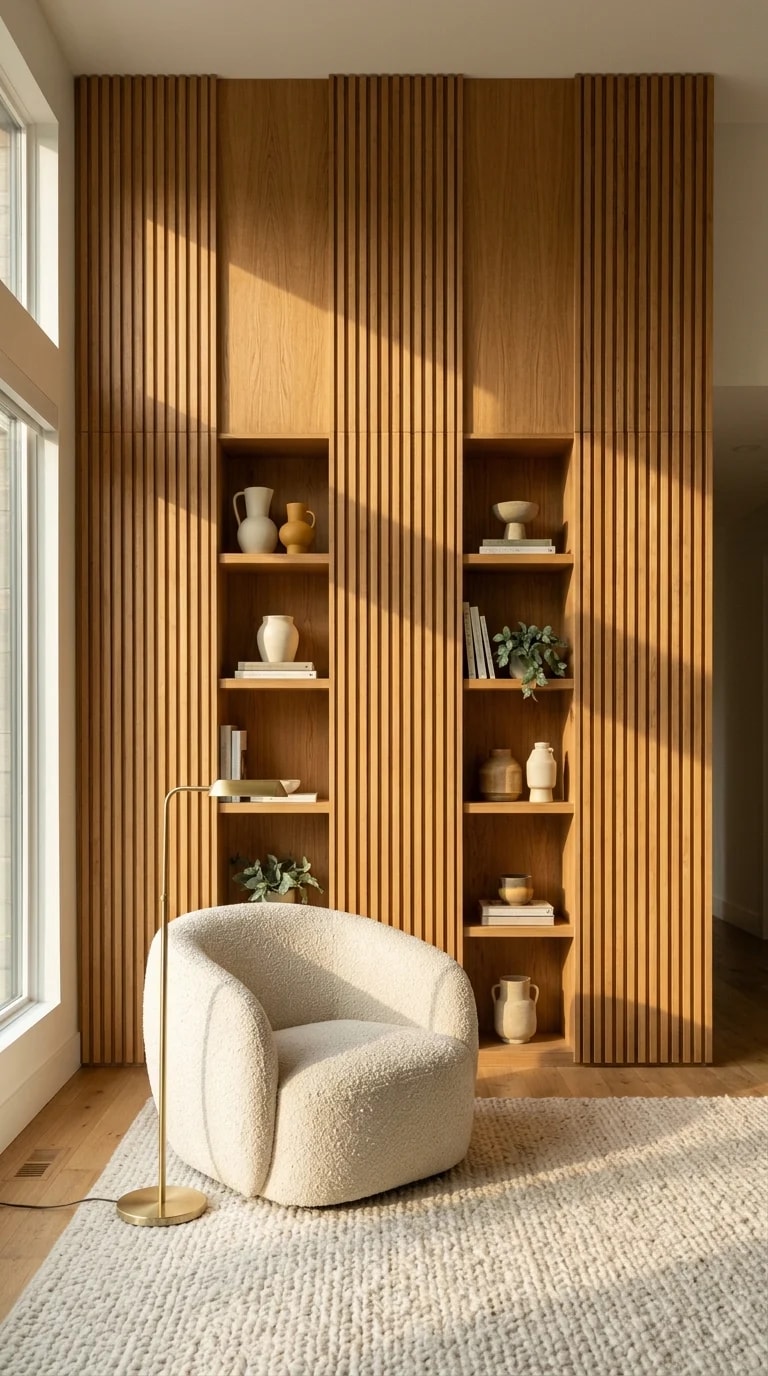
Most people photograph a wall like this one once, from the doorway, and call it documented. The better habit is to return to it four or five times in a single day. Vertical oak slats are unusually generous subjects because they behave like a ruler: the sun crosses them at an angle and the gaps throw long diagonal bars that lengthen, thin out, and finally dissolve. If you keep a home design journal, give one spread to that sequence alone. Sketch the bars roughly, note the hour, and write down what the light actually does to the wood — whether it turns honey at ten and amber by four, whether the terracotta vases go coral or brick.
Pay attention to the joinery details as the shadows find them. The two recessed shelving columns sit slightly deeper than the slats, so they hold a softer, dustier light while the slats in front stay crisp and graphic. That contrast is the whole point of the wall, and it disappears under flat overhead lighting at night. Log it. Note the cream and ivory ceramics, the small bowls stacked two deep, the trailing plant that will eventually need a haircut because it has begun to reach for the window. A journal entry that records what sits on a shelf in June becomes a small archive of what you actually own and love, which is far more useful than a mood board of things you don't.
Then widen the frame. Write about the chair. A rounded bouclé armchair pulled close to a brass floor lamp tells you how the room expects to be used: one person, one book, an hour of nothing. In your notes, describe the distance from the chair arm to the warmest patch of sun and decide, honestly, whether it is close enough. Small measurements like this convert a pretty photograph into a decision you can repeat in another room — the lamp two hand-spans from the chair, the rug pale enough to bounce light back up at the slats, the floor left bare where the sun lands.
Keep the pages imperfect. Tape in a fabric snippet from the chair, a paint chip for the oak stain, a pencil rubbing of the slat spacing. The value of a design journal is not neatness; it is specificity, and specificity is what lets you explain a room to a carpenter or a joiner without waving your hands. Come back to the same entry in winter. The sun will sit lower, the diagonal bars will stretch further across the pale rug, and you will see at once which decisions were about light and which were only ever about taste.