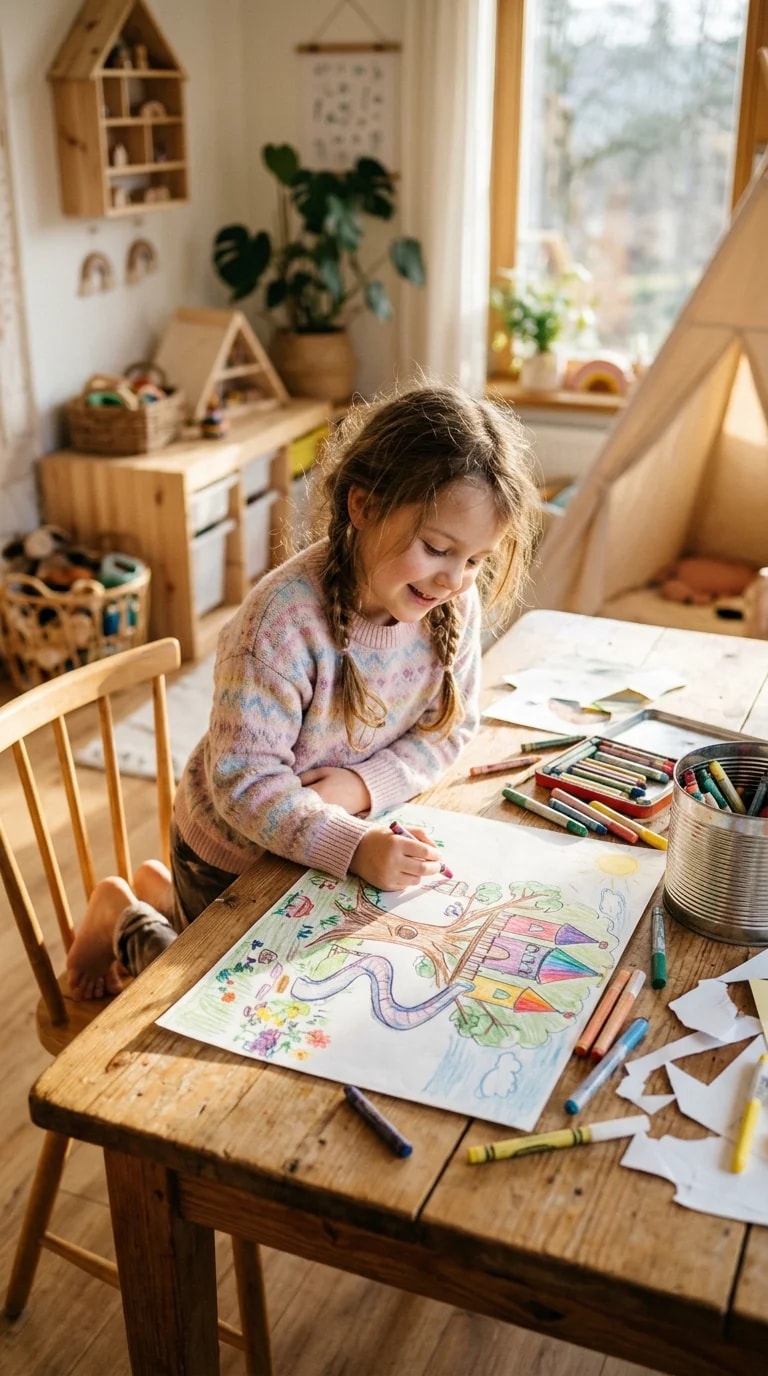
Watch a child color a house and you will see the whole scheme in miniature: a cream facade, a bright door, a rainbow that refuses to apologize for itself. That instinct is worth borrowing. The most livable rooms tend to follow the same recipe — a soft, expansive base, a warm wood middle, and a small handful of pastel accents allowed to be cheerful. Children do not agonize over whether lilac and butter yellow belong together. They put them down and move on, and the drawing works because the background was generous enough to hold them.
Start with the base. Cream walls, oatmeal textiles, and a beige rug keep the room quiet so the wood can do the talking. Honey-toned oak, waxed pine, and worn bamboo all carry a slight orange warmth that flatters skin tones and makes diffused daylight feel softer than it is. In a room like this one, the wooden table, chair, storage unit and hanging house-shaped shelf are not competing finishes — they are variations on a single note, which is why nothing feels busy even with baskets, plants and paper scraps everywhere.
Then add the crayon colors, but ration them. The trick is to treat pastels as accents with a clear job: a lilac-and-pink sweater over the back of a chair, a few cushions, a stack of books, a ceramic vase. Two or three pastel hues are plenty, and they read best when they sit against cream rather than against each other. If you want the rainbow energy of a child's drawing without the nursery effect, choose one cool pastel and one warm pastel — say lilac and peach — and repeat each of them three times around the room. Repetition is what makes a scattered color look intentional.
Bright crayon shades deserve a smaller role still. A single saturated note, whether it is a red tin, a green plant, a yellow pencil cup, or a piece of children's art taped to the wall, gives the eye somewhere to land. Keep those moments low and small, at table height or below, so the upper half of the room stays calm and the ceiling feels high.
Finally, let the palette age with the family. Cream and honey wood are forgiving of fingerprints, crayon smudges and the slow accumulation of toys. Pastels can be swapped seasonally through textiles alone, no repainting required. The result is a room that feels nostalgic without being stuck in a decade — the color logic of a drawing, translated into a home that can actually be lived in.