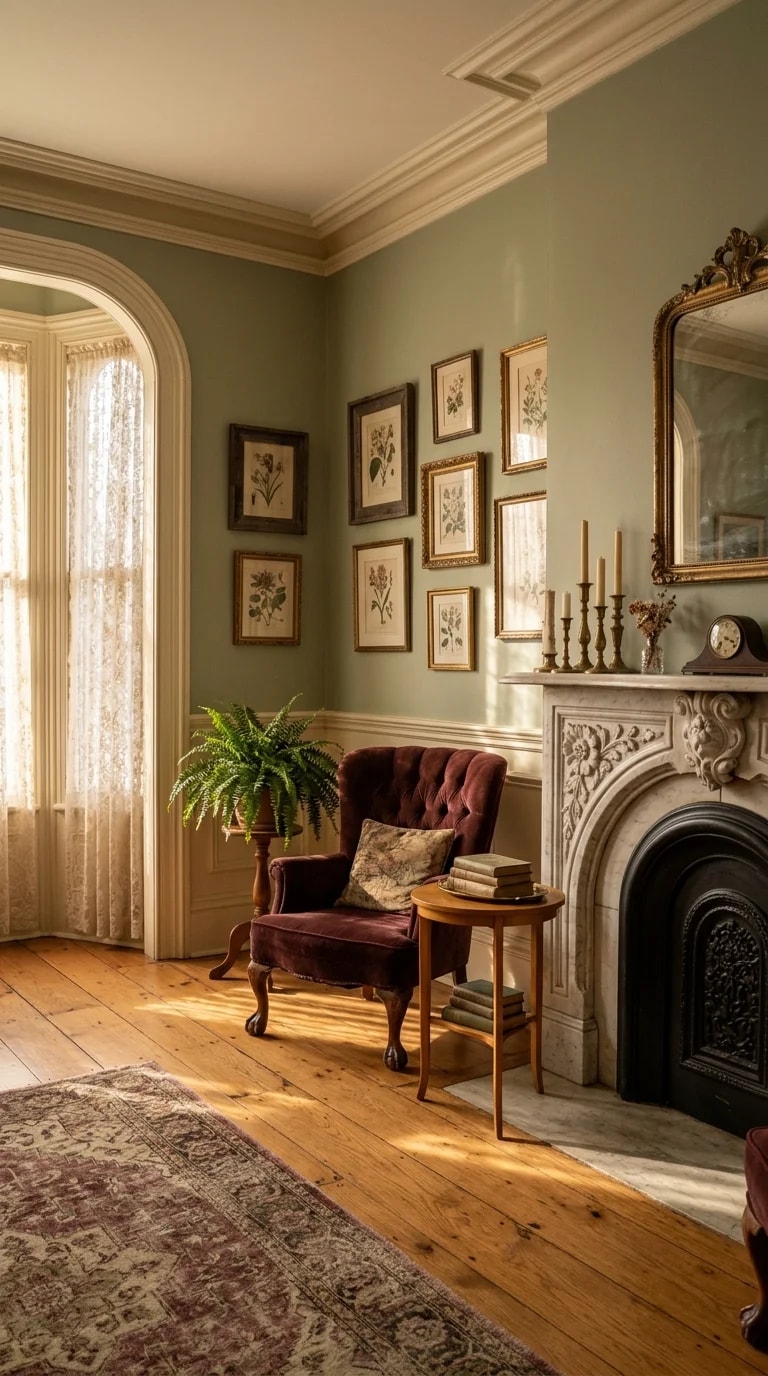
Most rooms are remembered for one corner. Not the whole floor plan, not the sofa everyone fights over, but a small pocket where light, color, and a single good chair agree to cooperate. This sitting-room corner earns that status because nothing in it is accidental. The sage-green walls with their white crown molding and wainscoting do the quiet structural work, framing the space without shouting, while the burgundy tufted armchair sits dead center as the one object allowed to raise its voice. Classic home design rarely depends on novelty. It depends on this kind of disciplined contrast, where a deep, saturated color is given space to breathe against a calm field of green and cream.
The fireplace is the corner's spine. Carved stone, dark and ornate, it would overwhelm a smaller room, but here it anchors the right side of the composition and gives the eye somewhere heavy to rest. Above it, a mantel of candlesticks and a clock keeps the styling low and horizontal, letting the stonework remain the event. Flanking it, a gallery wall of framed botanical prints climbs the wall in soft greens and aged paper tones, offering pattern without competing for attention. A gilded mirror catches a sliver of the window and doubles the daylight, which is the oldest trick in the classic playbook and still the most effective.
The left side of the corner belongs to the window. An arched frame, lace curtains filtering rather than blocking, a potted fern on a wooden stand leaning into the light. That fern matters more than it seems: classic rooms need something alive in them, or the symmetry turns stiff and museum-like. The small round side table stacked with books is the second human touch, placed within arm's reach of the chair because someone actually intends to sit there. Long shadows stretch across honey-toned wood floors and a patterned rug, and those shadows are the room's real decoration, shifting hour by hour and costing nothing.
What ties it together is a restrained palette: sage, cream, burgundy, warm wood, a little black. Five notes, no more. The wood tones repeat across the floor, the table, and the picture frames, so the eye registers continuity without being able to name it. The rug carries every color in the room at low volume, which is why it sits so comfortably underfoot.
If you want to borrow the formula, start with the chair. Choose one saturated, dignified color, set it against pale walls with generous white trim, and give it a window on one side and something heavy and architectural on the other. Then stop adding. The corner is finished when it feels like somewhere a person could sit with a book for an hour and forget to check the time.