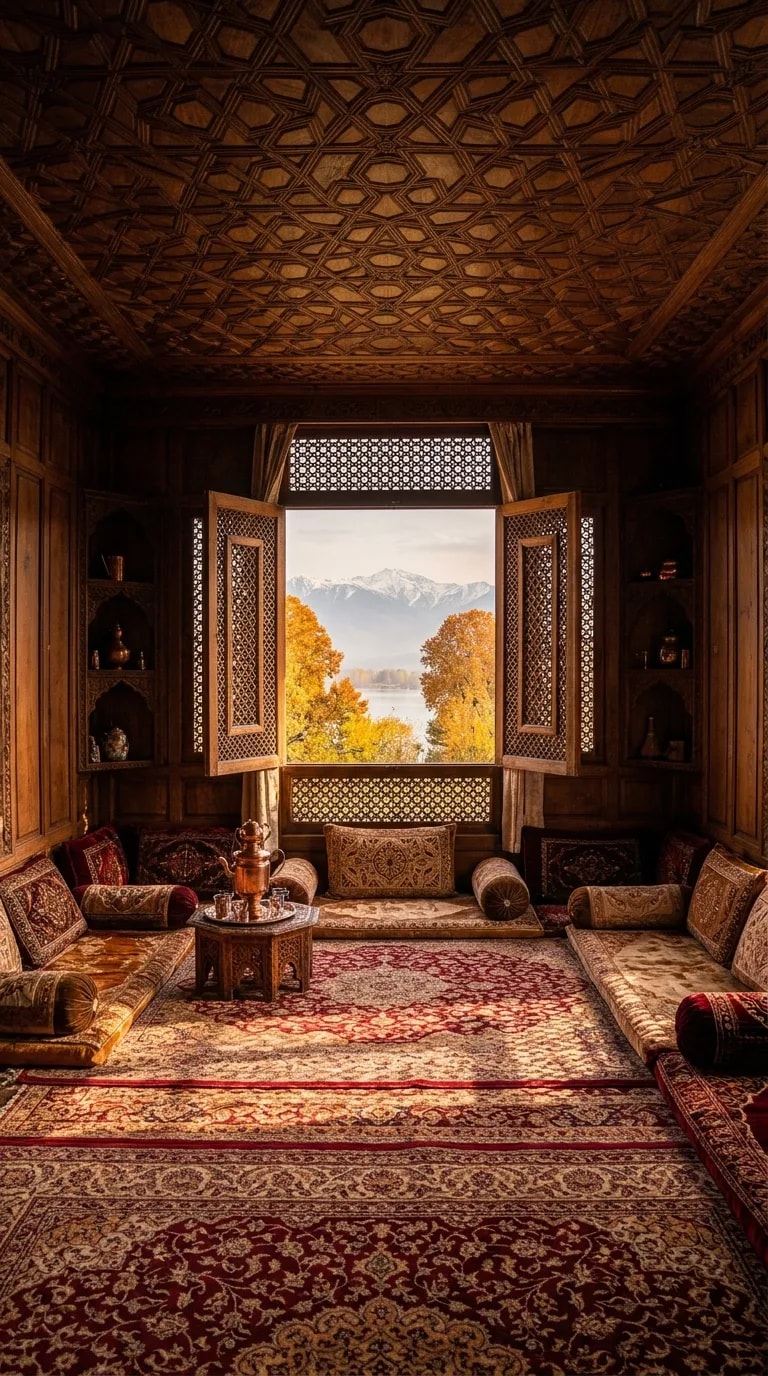
Some rooms announce themselves with color or furniture. This one does it with a rectangle of light. A deeply carved wooden ceiling spreads outward from the center like a fan, and every line in the space — the wall niches, the rug borders, the low seating arranged on either side — points toward the open latticework shutters. Beyond them, snow-capped mountains and turning foliage sit in cool blues and autumn yellows, framed like a painting that changes with the hour. Warm sunlight lands on deep reds, golds, and browns inside, so the room feels lit from within as much as from above.
The most useful idea here is also the simplest: treat one window as the organizing template for everything else. Choose the best view in the house, center it, and build outward in matched pairs. Here, symmetrical niches echo each other across the wall, the ceiling's geometry mirrors the framing of the shutters, and the seating sits balanced rather than scattered. Nothing competes with the landscape. If you want to borrow the approach, start by measuring sightlines from the doorway. Whatever your eye lands on first should be the thing you most want to see, and the architecture around it should repeat that decision rather than argue with it.
Materials do the quiet work of holding the composition together. Carved wood gives the ceiling and shutters a shared texture, so pattern reads as craft instead of decoration, and the eye can rest on it without the room feeling busy. The palette is disciplined: warm browns and reds inside, cool greens and blues outside, with gold accents bridging the two. Deep, ornate rugs anchor the floor and keep the low furniture from floating in all that open space. Notice how the textiles carry most of the detail, which lets the walls and ceiling stay relatively calm and the view stay dominant.
Then there is the seating, arranged close to the floor around a single central table. It is a template for lingering rather than passing through — cushions instead of tall chairs, tea within reach, nothing taller than the windowsill to block the view. The practical lesson is about heights: keep furniture low, keep the window line clear, and layer rugs and cushions generously so floor-level sitting feels plush instead of makeshift. A room built this way asks you to stay a while.
What makes the space timeless is that the window does the decorating, season after season. Snow, rain, and autumn color all become part of the interior. Build the frame, keep the symmetry honest, choose materials that age well, and let the landscape handle the rest.