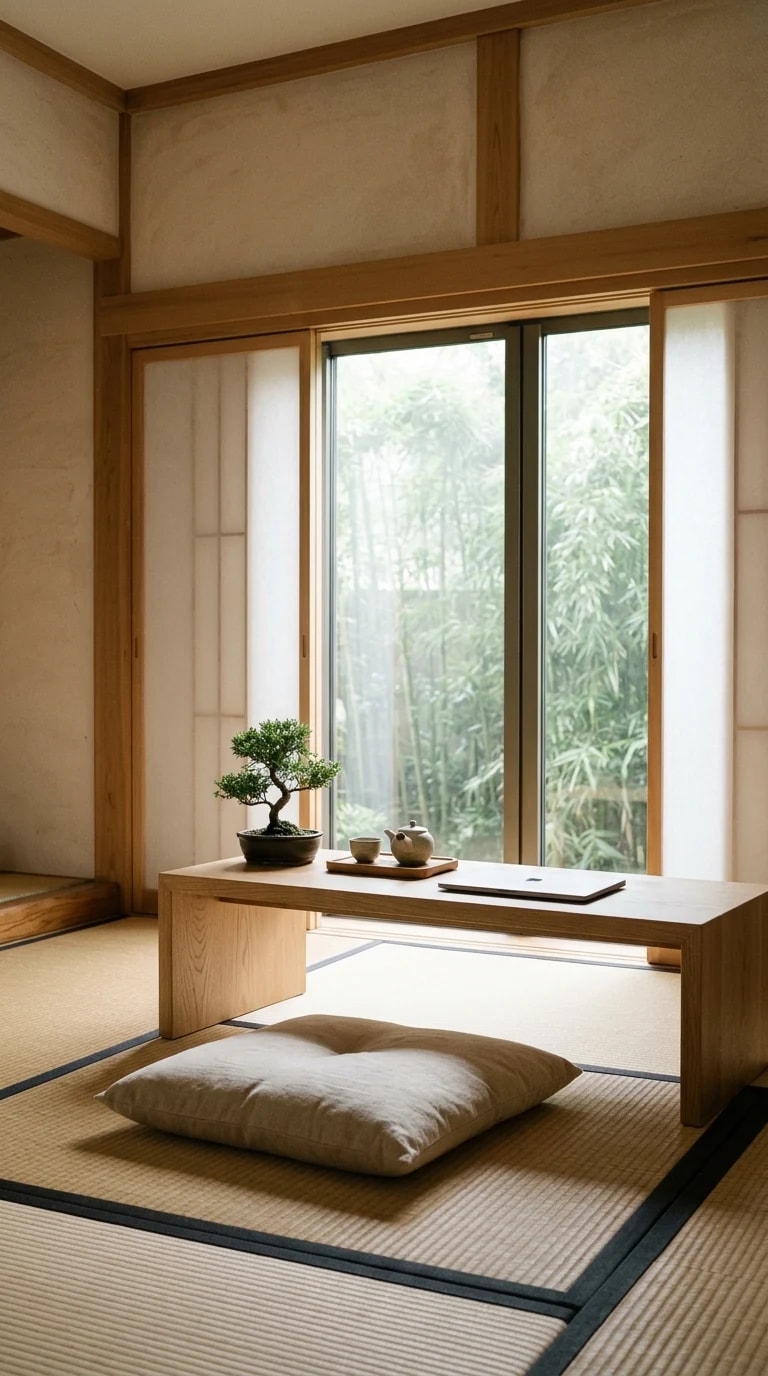
There is a room in the 2026 house that refuses to be useful. It has no screen, no desk, no storage wall. It holds a low table of pale oak, a bonsai with three careful bends in its trunk, a ceramic pot and two cups, and a single beige cushion that looks like it has been waiting all afternoon. Sliding paper screens filter the light into a warm haze, and beyond the glass a stand of bamboo turns the view into something closer to weather than landscaping. Nothing here asks anything of you. That is the entire point.
The architecture of this calm is deliberate, not accidental. The composition is symmetrical, almost ceremonial, with the table centered on the window so the eye travels straight out into green. Tatami mats with dark cloth borders set the proportions; their grids quietly tell you where to sit without a single chair. A charcoal line runs through the scheme, the way a brush stroke anchors a wash of ink, keeping all that beige from drifting into blandness. Light is the real material. Screens and shoji diffuse it, so the room never glares, and the grain of the wood stays readable from morning to dusk. There is no overhead fixture competing for attention, because there is nothing to spotlight.
What makes this more than a mood board is how quickly the room changes behavior. Sitting on the floor lowers your center of gravity and slows the pace of everything: pouring tea becomes a sequence instead of a reflex, and a phone left at the doorway stays there. In a year when home design 2026 keeps circling the same idea, restorative living, this is the most literal version of it. Build one room, or one corner, that has a single job, and let that job be nothing more demanding than attention.
The good news is that this is the cheapest renovation in the house. You do not need a bamboo grove or a traditional Japanese structure to borrow the logic. Take the quietest window you own, clear the sill, and place a low ledge or table beneath it at knee height. Choose one plant with structure rather than a shelf of trailing greenery. Keep the palette to warm beiges, sand, and unbleached linen, then add two or three dark lines, a frame, a tray edge, a border, so the softness has bones. Store the clutter somewhere else, and resist the urge to fill the empty wall with shelves.
The luxury in this room is not the materials. It is the vacancy. A house full of rooms that perform, that host, that work, that store, eventually needs one that simply holds still, and 2026 is the year that vacancy became a design goal worth planning for.