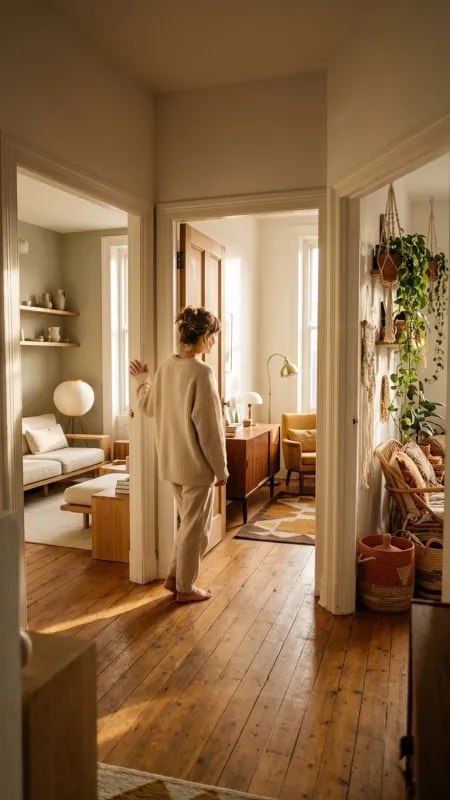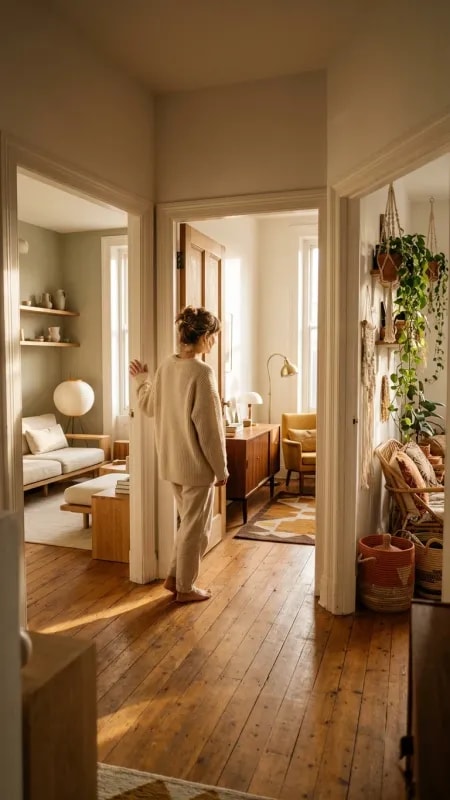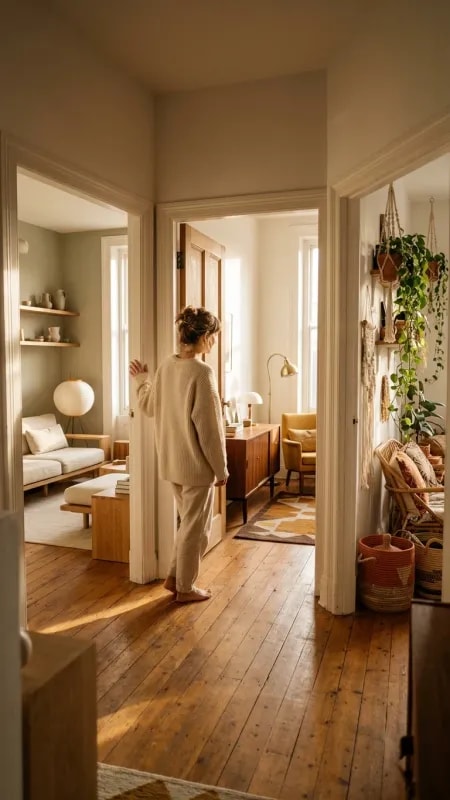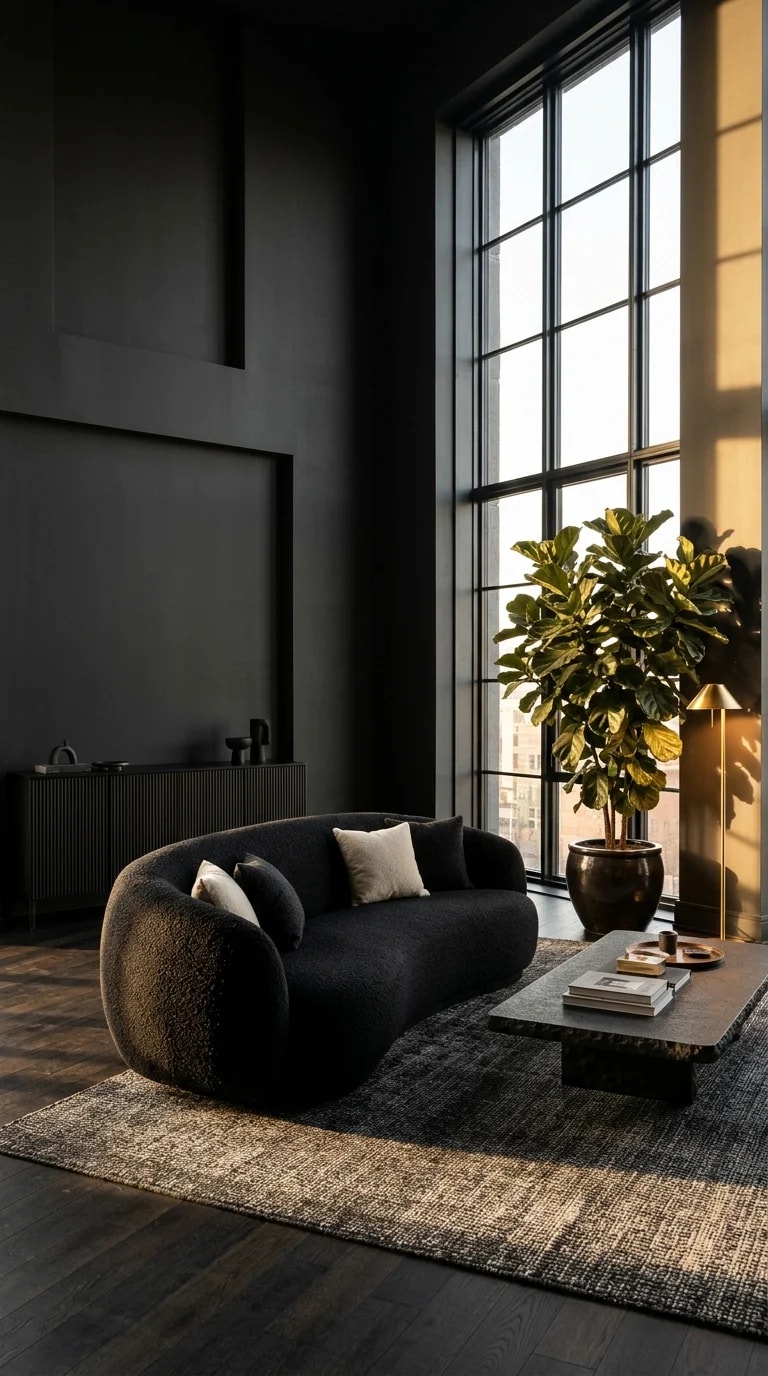
There is a moment, just before the sun clears the building opposite, when this room seems to hold its breath. Charcoal walls swallow the corners, the tall gridded window reads as a lit rectangle of graph paper, and the rounded black sofa sits low in the frame like a shape brushed onto the surface. Then the light arrives and lays hard-edged parallelograms across the floorboards, the rug and the seat cushions. Nothing in the room moves, yet everything changes. That is the quiet mechanism of a dark interior done well: it isn't gloomy, it's staged, waiting for the sun to finish the composition.
The design logic here is closer to poster art than to decorating. Vertical lines repeat in a deliberate rhythm — window mullions, the ribbed front of the sideboard, the seams of the wood floor, the slim stem of the floor lamp at the right edge. Against all that structure, the sofa's curve does the work of a single bold gesture, softening the grid without fighting it. Negative space matters as much as furniture. The dark wall planes above the sofa are left empty on purpose, which is why the fiddle-leaf fig, glossy and near-black in its pot, reads as sculpture rather than houseplant.
Black alone would fall flat, so texture carries the counterweight. A nubby taupe rug scuffs the polish of the floor. Cream cushions break the sofa's silhouette into something you actually want to sink into. The low stone-and-wood coffee table brings in a matte, chalky grain, and a small metallic accent on the lamp catches whatever light drifts past. Even the styling on the sideboard is restrained — a couple of small sculptural objects, spaced with air around them, the way a catalogue shoot would place them and then remove half.
To build a version of this at home, start with one rounded or sculptural piece and let everything else stay straight-edged. Keep the palette to near-black, charcoal, warm taupe, olive and cream, then add a single hit of gold or brass where the light lands. Choose fabrics with visible weave, because flat surfaces disappear in low light. Put the tallest plant where the window's shadow will cross it, and resist the urge to fill the walls; the emptiness is what makes the room feel expensive.
What you end up with is a room that behaves differently at four in the afternoon and nine at night — graphic by day, cocooning after dark. That duality, more than any single object, is the idea worth copying.