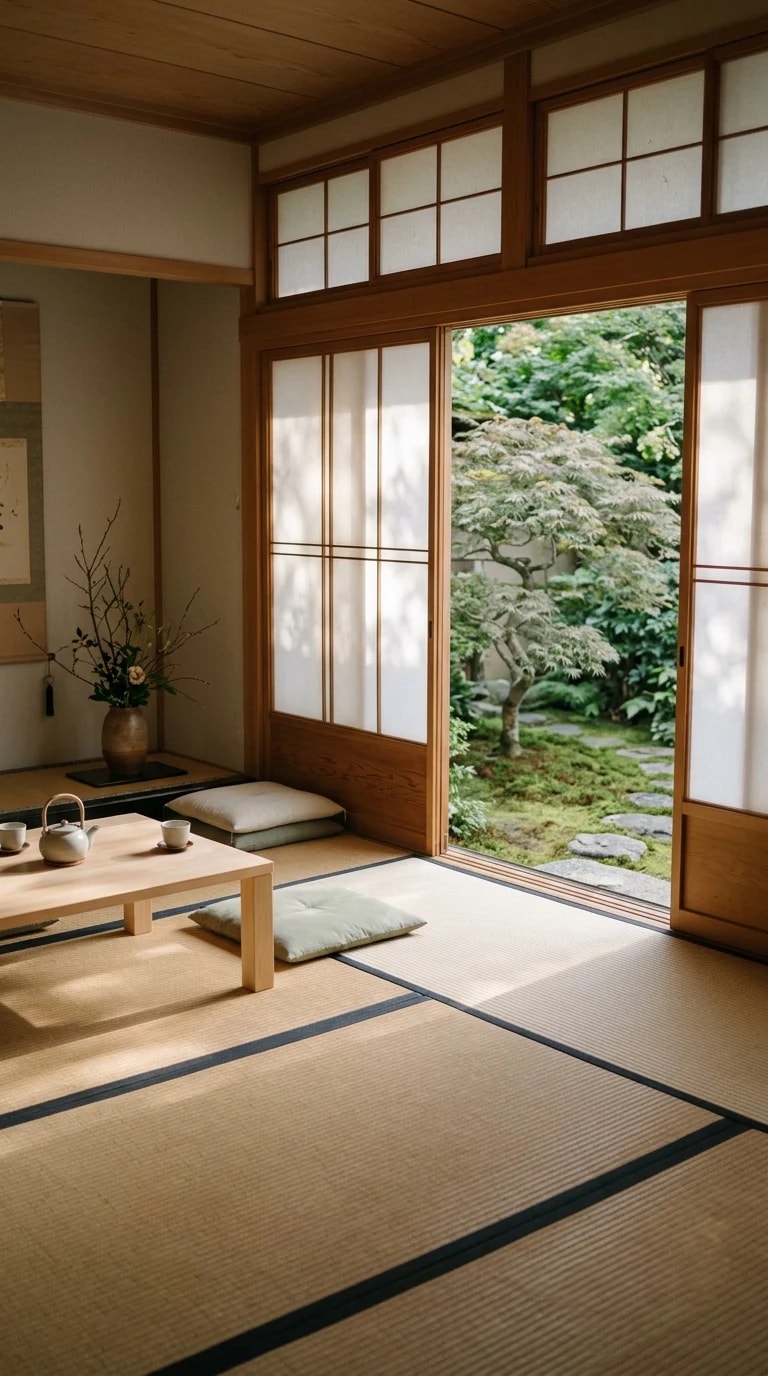
The first thing the doorway does is refuse to behave like a doorway. Framed by dark timber posts and a shadowed ceiling beam, the opening holds a low table, a teapot, a few floor cushions — and then, without a pause, a stone path slipping between moss and a single sculpted tree. Stand inside and the garden reads as a picture. Stand in the garden and the room reads the same way. That doubled view, a frame inside a frame, is the entire trick of the space, and it costs nothing but intention.
Inside, everything is measured. Tatami mats lay a quiet grid across the floor, their woven surface catching daylight in soft horizontal bands that shift through the afternoon. Shoji screens are slid fully back into their pockets, so the wall becomes an absence rather than a barrier. In the recessed alcove, one branch and a single stem sit in a plain vessel; on the table, a teapot and cups wait at exactly the height of a seated person's hand. Nothing here is decorative for its own sake. Each object earns its place by being useful, beautiful, or both, and the emptiness around them does as much work as the objects themselves.
The garden is not scenery attached to the room; it is the room's last material. A stepping-stone path draws the eye outward, low plantings keep the horizon at seated eye level, and the tree is pruned into a shape that reads clearly against the pale interior. This is where a home design tails off instead of stopping dead at a pane of glass — the threshold is a line of shadow on the mat, and the transition happens in the body as much as in the eye. Warm wood, crisp white paper and vivid green do all the color work, and natural light handles the rest, throwing gentle shadows that soften every hard edge.
You can borrow the logic without importing a Japanese house. Sink the floor or level it at the doorway so there is no step to trip the transition. Push the opening as wide as the structure allows, then frame it with a deep reveal of timber. Keep furniture low enough that a window becomes a view rather than a ledge, and edit hard: one table, one vessel, one branch. Plant for the height of a seated person, not a standing one, and let a path lead somewhere visible rather than vanishing into hedge.
The reward is a room that slows you down before you decide to slow down. A kettle, a warm cup, a rectangle of green light on beige mat — the architecture has already done the meditating for you.