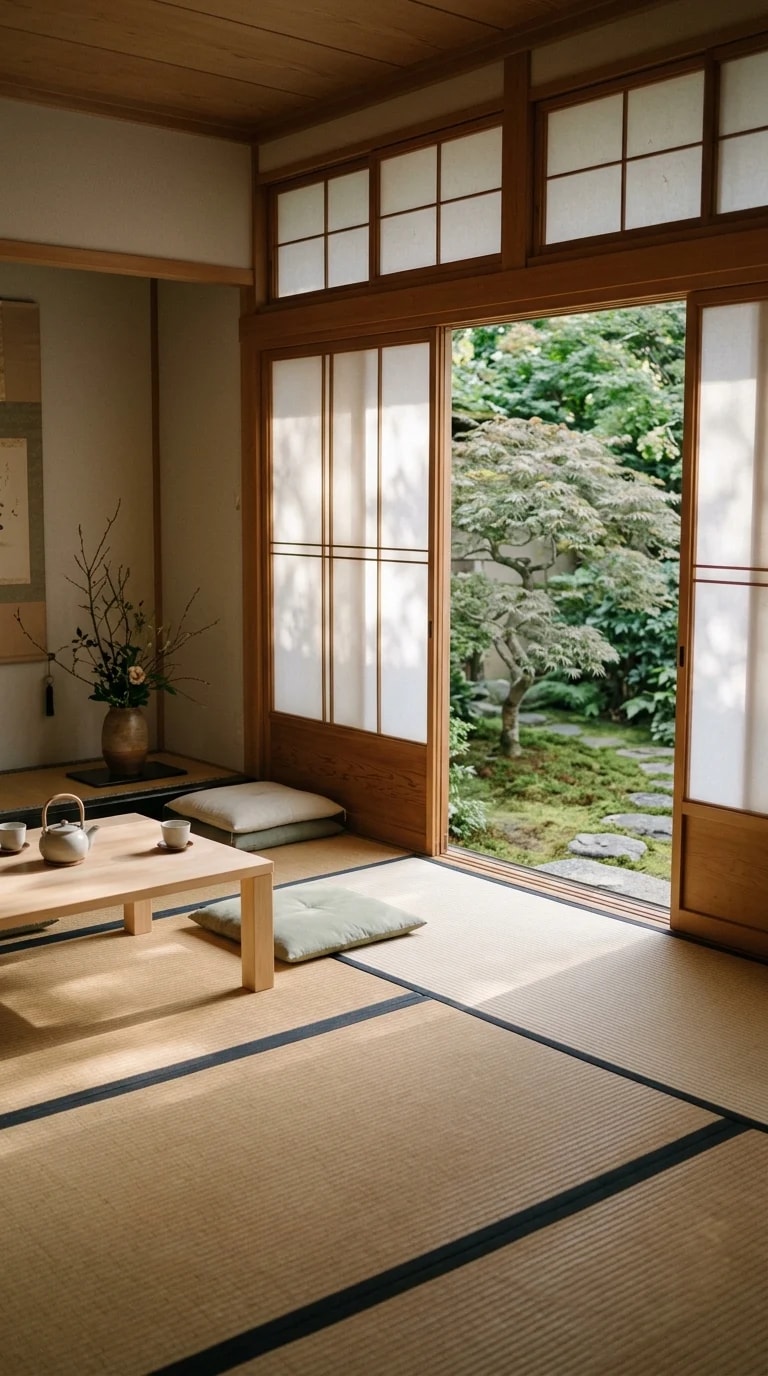
There is a particular kind of room in Korean home design that refuses to end. You sit on a woven mat at a low table, a small teapot cooling beside you, and the wall in front of you is not a wall at all but a set of paper-paneled doors slid wide open onto moss, stone and a maple holding its leaves very still. The room does not stop at the frame. It keeps going, past the wooden sill, into the green. That single decision — treating the garden as the last piece of furniture — is what makes this space feel so much larger and calmer than its square meters suggest.
The bones are simple and worth copying. The floor is covered in tightly woven mats with dark cloth binding, laid in a grid that gives the eye something to rest on and the feet something warm. Above, a low ceiling of exposed timber keeps the proportions human. The palette never strays: honeyed wood, undyed paper, straw, a whisper of beige linen on the cushions. Because nothing competes, the green outside reads as color, not clutter. If you are working with a modern apartment, you can borrow this by choosing one dominant wood tone and refusing to introduce a second, and by running a single rug or mat wall-to-wall in a room that opens onto a balcony or courtyard.
The framing is the real architecture here. Thick posts and a deep lintel turn the opening into a picture, and the paper screens filter daylight into something closer to candlelight than sunshine. Notice how the light lands: soft on the mats, brighter at the threshold, brightest in the garden. That gradient is what pulls you forward. To get it at home, hang a sheer linen or rice-paper shade in front of a glass door and let it stay half drawn. You lose a little view and gain the thing the view was for — atmosphere.
Then there is the ritual of keeping it spare. A hanging scroll, a single branch in a low vessel, a tea set that fits on a tray. Each object is given room to be looked at, which is the opposite of how most of us decorate. The discipline is not austerity for its own sake; it is hospitality. A room this quiet makes space for the person sitting in it, and for the guest across the table. That is the idea to take away, whether or not you own a garden: build one threshold in your home where the inside and the outside are allowed to touch, keep the materials honest, and leave enough empty floor for someone to sit down and breathe.