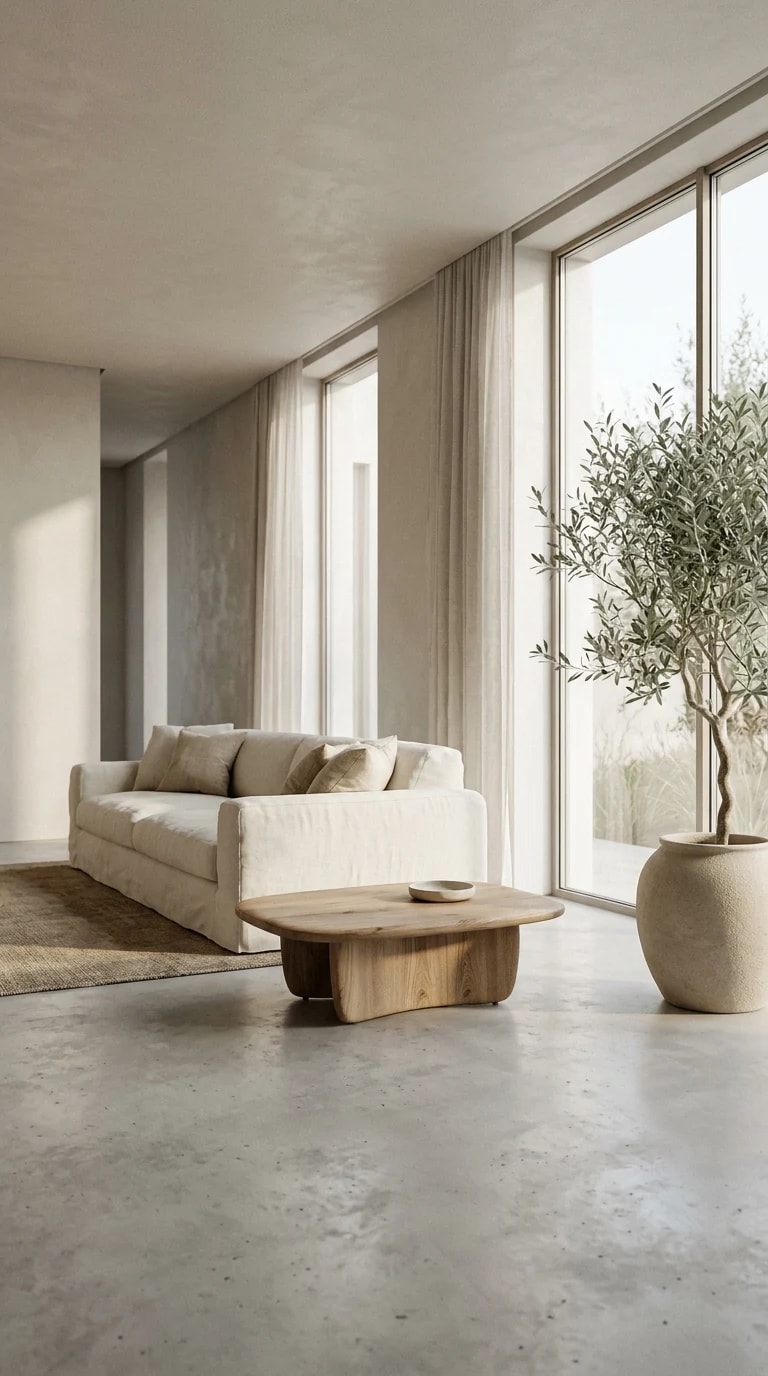
Stand at the doorway of a room like this and your eye does something unusual: it skips the furniture. The sofa is low and pale enough to read as a shadow, the coffee table has no hard corner to snag on, and the olive tree simply marks where the room ends. What registers first is the stretch of polished concrete between the seating and the window wall, all that mottled grey holding the afternoon light. That bare strip is not leftover space. It is the design, and it is the reason the room feels like somewhere you could think.
Most home offices are assembled the other way around. We buy the desk, the shelf, the filing cabinet, the second shelf, and then look for whatever floor is left to walk on. The result is a room that gives your eyes nowhere to rest, which quietly means your attention has nowhere to rest either. Negative space is the cheapest material you will ever work with and the hardest to protect. It only exists if you decide, on purpose, how much floor you are willing to leave alone, and then refuse to fill it. In this room the answer looks like roughly half.
Keeping that much emptiness demands a few quiet disciplines. Give the room one plant rather than five, and make it a tall one, so the greenery reads as architecture instead of decoration; an olive works because its canopy is loose and doesn't crowd the light. Choose a desk that behaves like the coffee table, warm wood with thin legs you can see past, and set it slightly off-axis from the window instead of pressed against it. The windows themselves stay dressed in sheer linen that diffuses daylight into an even wash, so you never work against glare or reach for a blind. And keep one soft textile within arm's reach, a throw or a flatweave rug over the concrete, because hard floors sound as bare as they look.
What you are really building is a backdrop for light. Polished concrete picks up the sheen of the curtains and the shifting green of the olive leaves and moves it around the room all day; sheer fabric turns a hard western exposure into something closer to a cloud. That is why the palette here stays within cream, greige and earth brown, with the plant as the single note of colour. Add a patterned rug or a bright chair and the light has competition. Leave the surfaces plain and every hour of the day looks slightly different, which is the closest thing a room has to being alive.
So the maintenance routine is subtraction, not decoration. Clear the desk each evening, water the tree once a week, notice when a new object has quietly claimed a corner and decide whether it earns the floor it stands on. Do that for a month and the room stops feeling unfinished and starts feeling breathable, a place where the first thing you do in the morning is look out of the window rather than down at a pile of things.