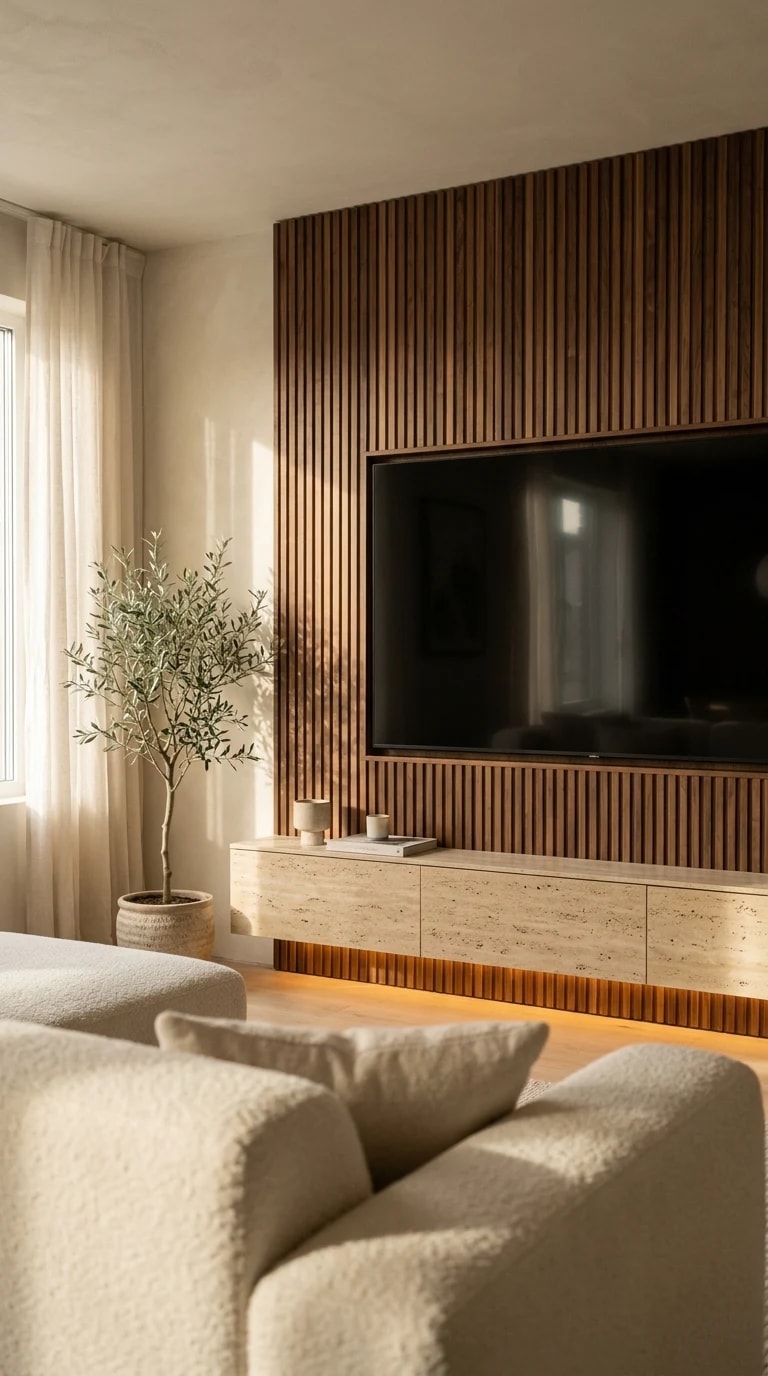
Every living room with a television has to answer one question: does the screen own the wall, or does the wall absorb it? This room answers quietly. Honey-toned oak slats run floor to ceiling, and the television is mounted flush across them at eye height, framed by the rhythm of the wood rather than floating alone in a field of white paint. When the screen is off, it reads as a dark, deliberate panel inside a warm vertical pattern. The room doesn't look like it's hiding a TV. It looks like it was designed around one.
The detail that does the heavy lifting is the floating console, set low and shallow so the floor stays visible beneath it. That gap matters more than the wood itself. A recessed strip of warm light glows under the cabinet and lifts the whole volume off the ground, which is why the wall feels buoyant instead of heavy. On top, the styling is almost defiantly small: a few candles, a shallow dish, a short stack of books. Nothing tall enough to compete with the screen. The olive tree beside the sheer curtains gives the composition its one living, irregular shape, leaning into the daylight from the left.
Asymmetry keeps the wall from feeling like a showroom display. The sofa and its cream boucle cushions anchor the bottom left, the slats dominate the right, and the window softens the edge so the join between wall and daylight is never a hard line. The palette stays tight on purpose: beige, oat, honey oak, a darker walnut in the shadows, and a muted green from the olive leaves. The black screen is the only cool note in the room, and that contrast is exactly what makes the wood look warmer.
If you're planning a version of this at home, three rules carry most of the weight. Keep the slat spacing consistent and narrow enough to read as texture from across the room, not as a fence. Run the slats past the screen on both sides so the TV sits inside the pattern rather than at its edge. And let the console stay shallow and low, because a deep cabinet will swallow the light underneath and turn a floating wall back into furniture. Get those right and the TV stops being the loudest thing in the room — it becomes one dark, quiet note in a very calm composition.