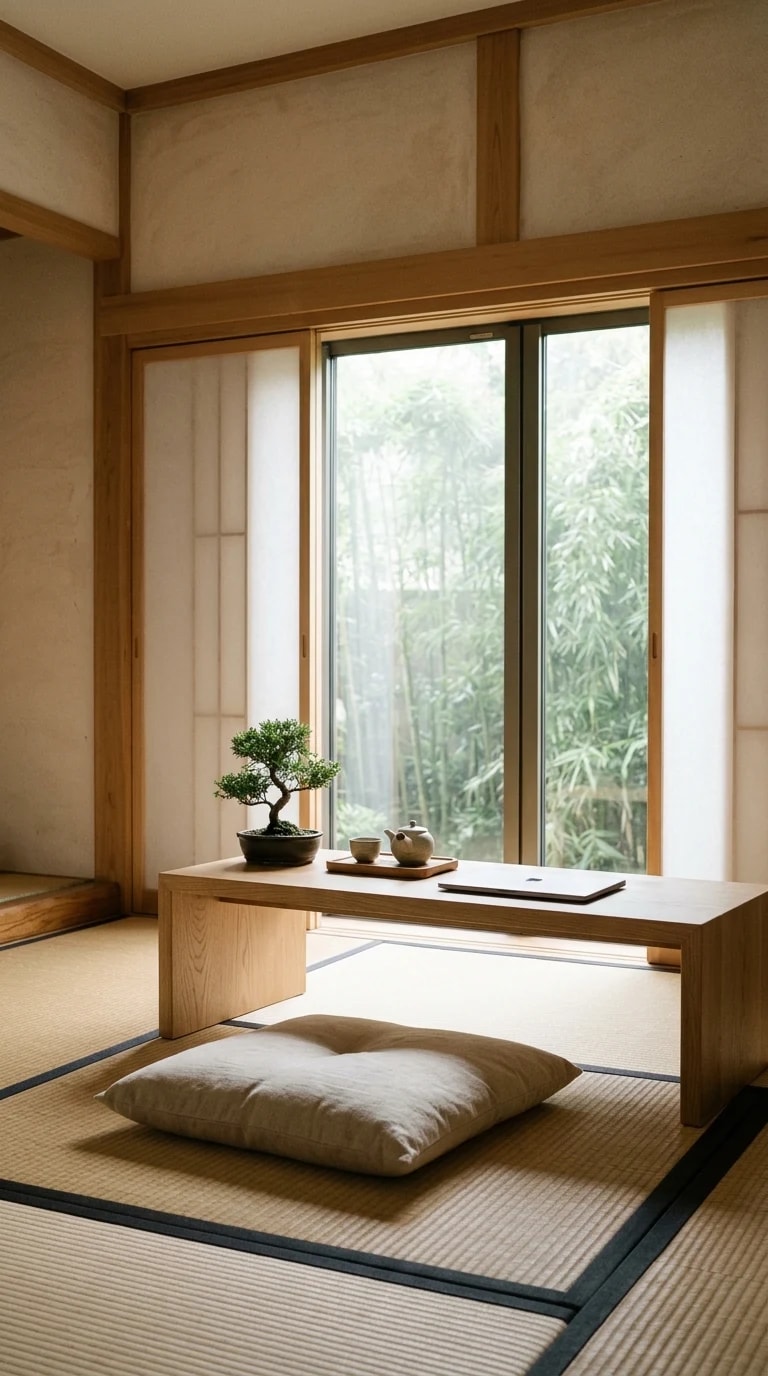
The room in this image does very little, and that is precisely the point. A low wooden table sits at the center of a tatami floor, holding a sculpted bonsai and a small tea set. A single floor cushion waits to be used. Beyond the glass, bamboo fills the window like a living screen, and the diffused daylight arriving through the shoji panels turns the honey-toned wood and cream walls into something closer to dusk than noon. Nothing in the frame is loud. Everything in the frame is deliberate.
This is what a single-floor home can offer that a two-storey plan rarely does: horizontality as a design philosophy. When there are no stairs to interrupt the eye, the floor becomes the true architecture. Rooms flow into one another along a continuous plane, and furniture drops close to the ground so that sightlines run straight out to the garden rather than stacking upward. Traditional Japanese houses built around this idea for centuries, with tatami modules setting the proportions of every room and sliding screens letting the boundaries between spaces dissolve whenever the household needed them to.
Materials carry the calm. Here it is pale timber, woven grass mats with dark cloth borders, and plaster walls kept free of ornament. If you are translating this into a build, keep the palette to three or four warm neutrals and let texture do the work instead of pattern. Pay attention to how light enters: shoji screens soften and scatter daylight so thoroughly that harsh shadows never form, which is why the room feels cool in summer and gentle in winter. Full-height glazing aimed at planting achieves something similar in a contemporary single-floor plan, especially when the glass is framed in the same wood as the interior joinery.
The threshold between inside and out deserves as much thought as any wall. In this room the garden is not a view so much as an extension of the floor plan, close enough to feel like another room with no ceiling. Landscape the ground immediately outside your largest window as if it were interior decoration: a few layered greens, a stone, a path that hints at movement. Privacy planting such as bamboo does double duty, screening neighbours while giving the eye somewhere soft to rest.
Restraint is the hardest part to copy and the most important. One table, one cushion, one living thing. A single-floor home designed this way asks you to edit relentlessly, and in return it gives you rooms that feel finished the moment you sit down in them.