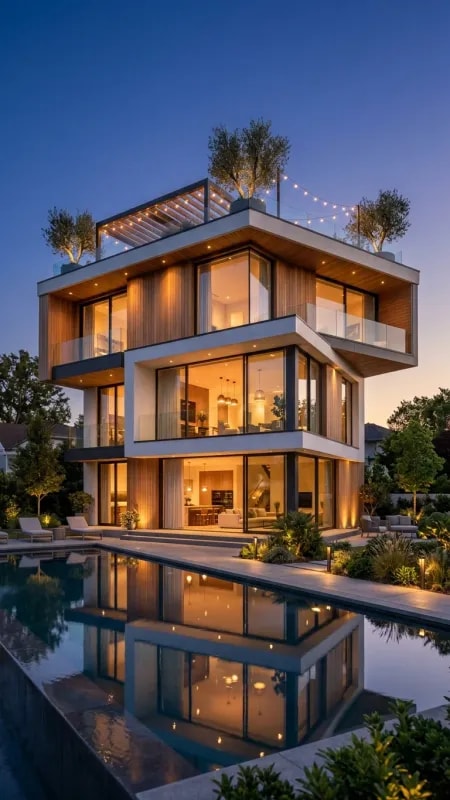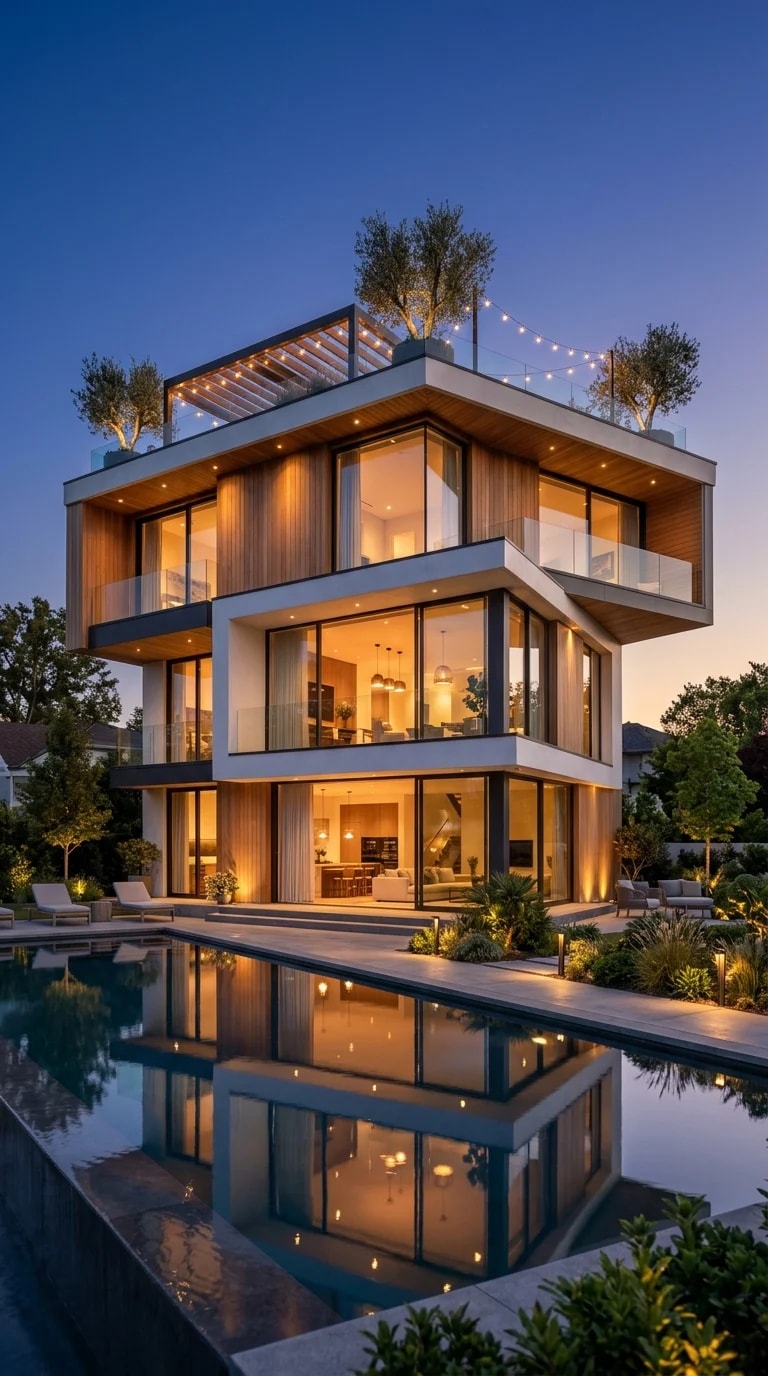
There is a particular hour in Japanese home design when the architecture stops being an object and becomes a light source. The sky has gone deep indigo, the water in the pool has flattened into a black mirror, and the house itself glows from within — honey-colored timber, warm interiors, a scatter of small lamps behind glass. Standing at the edge of the property, you see the building twice: once upright, once reflected, and the doubling makes the whole composition feel calmer than it has any right to. This is the oldest trick in the Japanese residential vocabulary, and it still works. A house is not a fortress against the night. It is a lantern you happen to live inside.
The cladding does most of the talking. Vertical timber slats run the full height of the facade, breaking a fairly substantial multi-storey volume into something quieter and more rhythmic. Screens like this have a long lineage — latticework, reed blinds, the fine wooden grilles that once filtered street light and neighborly curiosity in equal measure. In a modern build the logic is the same: the slats screen the bedrooms, soften the glare, and throw a striped shadow across the interior in late afternoon. Between the boards, glass runs almost floor to ceiling, so the boundary between inside and out is more suggestion than wall. Deep eaves above keep the summer sun off the glass while letting the low winter light slide all the way to the back of the room.
The rooftop terrace is where the design exhales. A pergola, a row of potted trees, a string of small bulbs — nothing extravagant, but enough to make an empty roof feel inhabited. Japanese gardens have always treated negative space as a material, and the same instinct applies up here: leave the middle open, push the planting to the edges, let one tree lean slightly off-center. Potted black pine and Japanese maple work well in containers because they hold their shape through winter, when the terrace is visible from the street and the lighting has to do the work of foliage. From below, the silhouettes read against the sky like a borrowed landscape, a garden you get to keep without owning the mountain.
The swimming pool earns its place by reflecting rather than entertaining. Set close to the facade, it catches the amber rectangles of the windows and stretches them into long, wavering columns. Uplighting in the beds keeps the trees visible without lighting the whole yard; inside, everything sits at roughly 2700 kelvin — lamps low, no downlights punching holes in the ceiling. Layer the sources and the house reads as inhabited from the outside, which is the entire point of a glass wall at night.
What makes it hold together is restraint. One timber, one stone, one planting palette, repeated. Get that right and the calm arrives on its own, every evening around dusk.