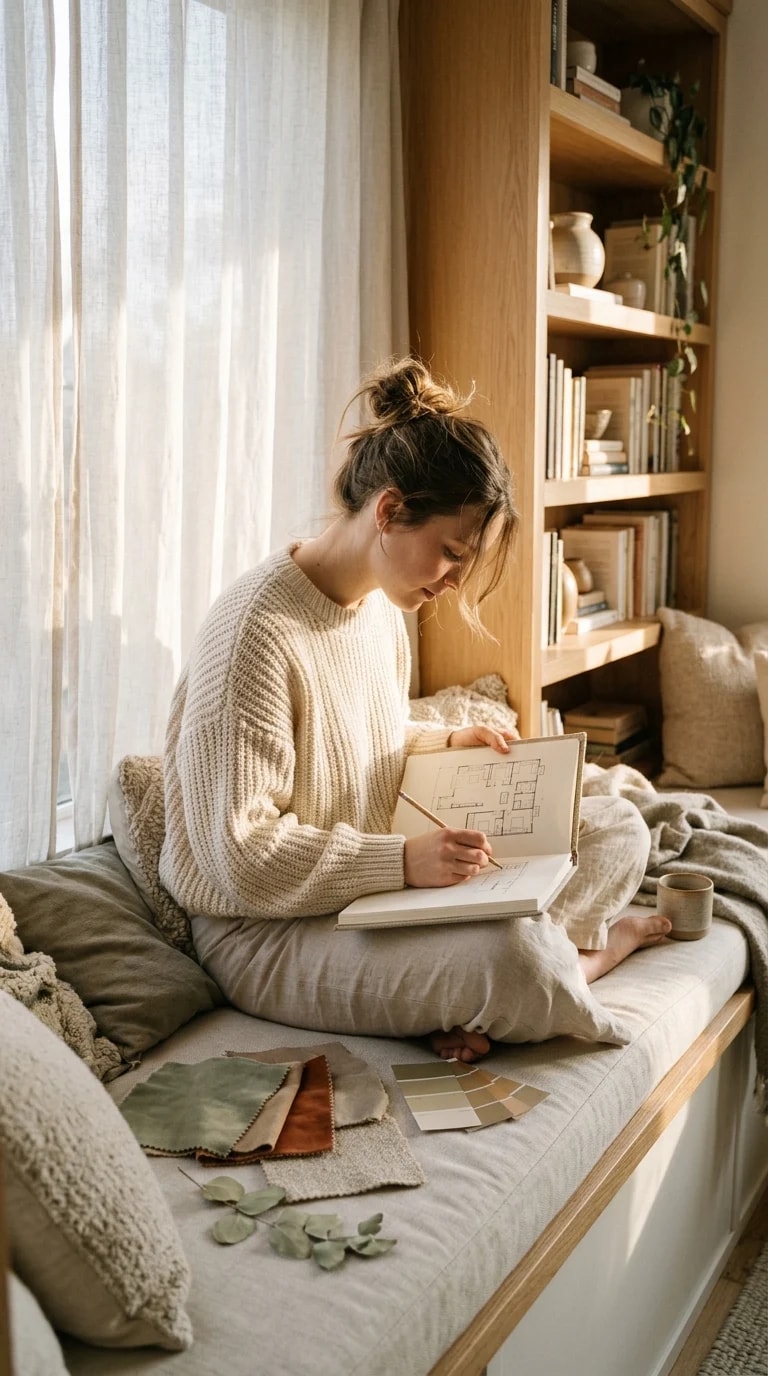
There is a particular kind of morning light that seems to belong only to older houses. It comes in sideways through sheer curtains, lands on a window bench, and turns a stack of fabric swatches into something worth lingering over. That is the promise of old-style home design: not a museum recreation, but a room that behaves like a patient host. The woman sketching a floor plan on that bench is doing what traditional interiors have always invited — planning slowly, by hand, with samples spread out like ingredients.
The first principle of the old style is built-in generosity. A window seat carved into the wall, a bookcase that reaches the ceiling, a shelf deep enough for a vase and a trailing pothos — these are gestures of permanence. Built-ins add architectural weight to a room, and weight is what makes a space feel settled rather than staged. If you cannot add structure, fake it: a tall wooden bookcase against a bare wall does the same work, especially when it is packed unevenly with books, ceramics, and one thing that does not belong.
Color is where old-style design gets misread. It is rarely beige for the sake of beige. Look closely at the swatches in a room like this and you find sage, rust, and oatmeal sitting together — muted, but not timid. The trick is to choose three earth tones with different temperatures, then repeat each one at least twice: rust in a cushion and a ceramic mug, sage in a leaf print and a throw, oatmeal in the linen and the knit of a sweater. Repetition, not contrast, is what makes an old-fashioned palette feel intentional.
Texture carries the nostalgia that color cannot. Chunky knits, slubby linen, hand-thrown pottery, and unfinished oak all catch light differently through the day, so a room never looks quite the same twice. Layer them without fuss — a textured throw folded over a bench cushion, a couple of linen pillows that never get plumped, a sprig of eucalyptus laid down rather than arranged. Old-style rooms are allowed to look slightly in use, because they are.
What holds it together is restraint in the bones and looseness in the details. Keep the architecture simple, keep the palette narrow, and let the soft things — curtains, cushions, books, branches — do the talking. Old-style home design works because it asks you to slow down: to sketch the plan by hand, to feel the fabric before you commit, and to let a quiet corner earn its keep as the best seat in the house.