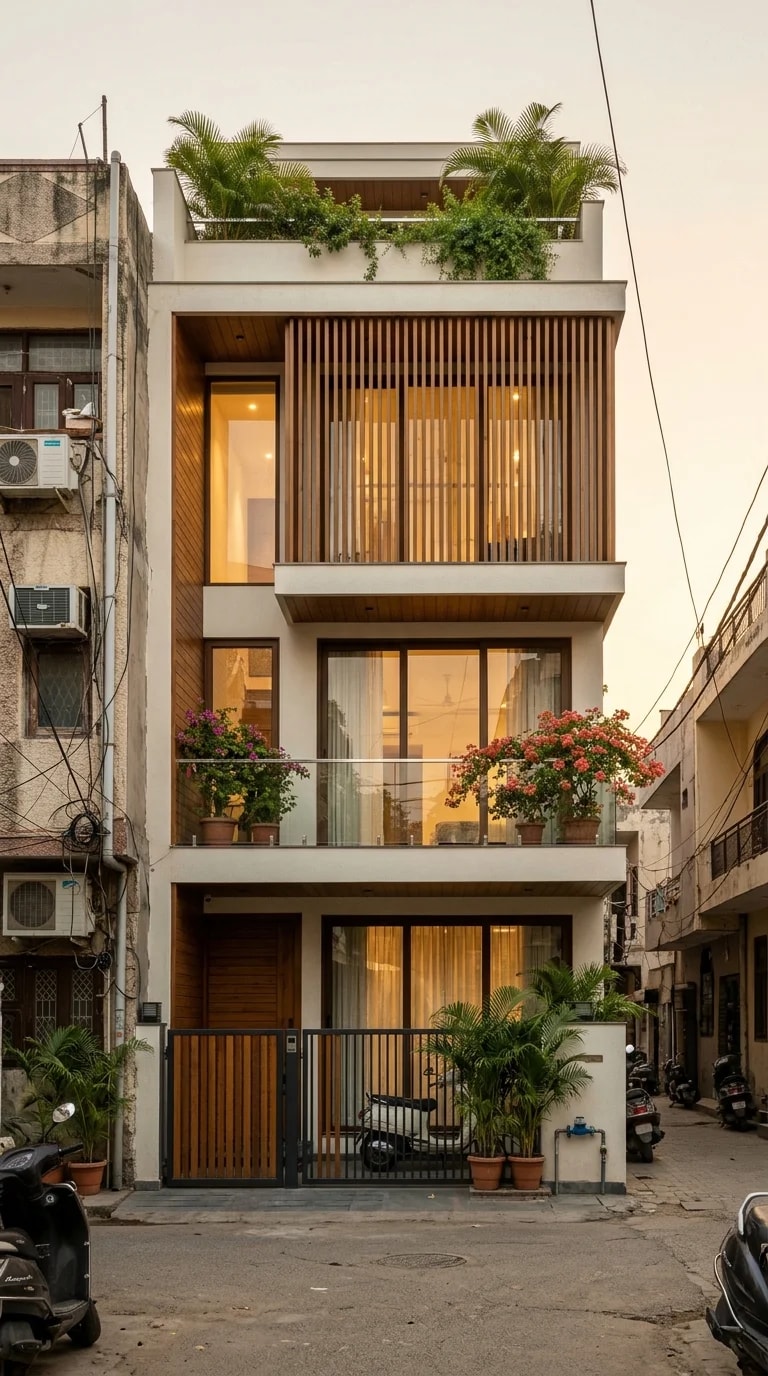
Every street has a building that seems to be making a point. On this one, it is the slim townhouse standing dead center, pressed shoulder to shoulder with older facades that have gone gray with weather and time. The photograph is taken straight on and slightly from below, so the house rises out of the frame like something planted rather than built. Scooters lean near a black metal gate, and the ordinary clutter of a city street carries on around it. Then the early evening light catches the timber, the glass, and the flowers spilling over the railings, and the whole block quietly rearranges itself around that warm glow.
What makes the house work is contrast handled with restraint. The neighbors are solid and closed; this facade opens up. Vertical slats of wood soften the flat plane and give the narrow frontage a sense of height, while the tall windows stay honest about what is inside — rooms, lamps, people moving through the evening. Nothing is shouted. Le Corbusier once wrote that the home should be the treasure chest of living, and that line gets quoted so often it has worn smooth. Here it feels less like a slogan and more like a description. The chest is not large. It is simply well made, and it is full.
Greenery does the rest of the talking. Balconies are crowded with trailing plants and bright pink flowers that spill past the railings, softening every hard edge the architecture provides. A rooftop garden caps the composition, closing the vertical line with leaves instead of concrete. This is the part of home design that quotations rarely capture: plants are not decoration added at the end, they are structure. They filter the view, cool the facade, and give a building a pulse. Anyone who has tried to write about why certain rooms feel alive usually ends up pointing at something green instead.
The gate deserves its own moment. A low black railing separates the street from the entrance without walling it off, which is a delicate balance in a dense neighborhood — private enough to feel protected, open enough to feel welcome. That threshold is where the design earns its calm. By the time the interior lights come on against the fading sky, the house is doing exactly what a sanctuary should do: offering shelter from the street while staying visibly part of it.
The lessons travel well beyond this one lot. Build for warmth before square footage. Let one material, repeated with discipline, carry the facade. Treat plants as architecture. Use glass to share light rather than to show off. And accept that a narrow site is not a limitation but a forcing function for clarity. The best quotes about home design tend to be short, and so is this house's argument: make a small place feel generous, and the street will remember it.