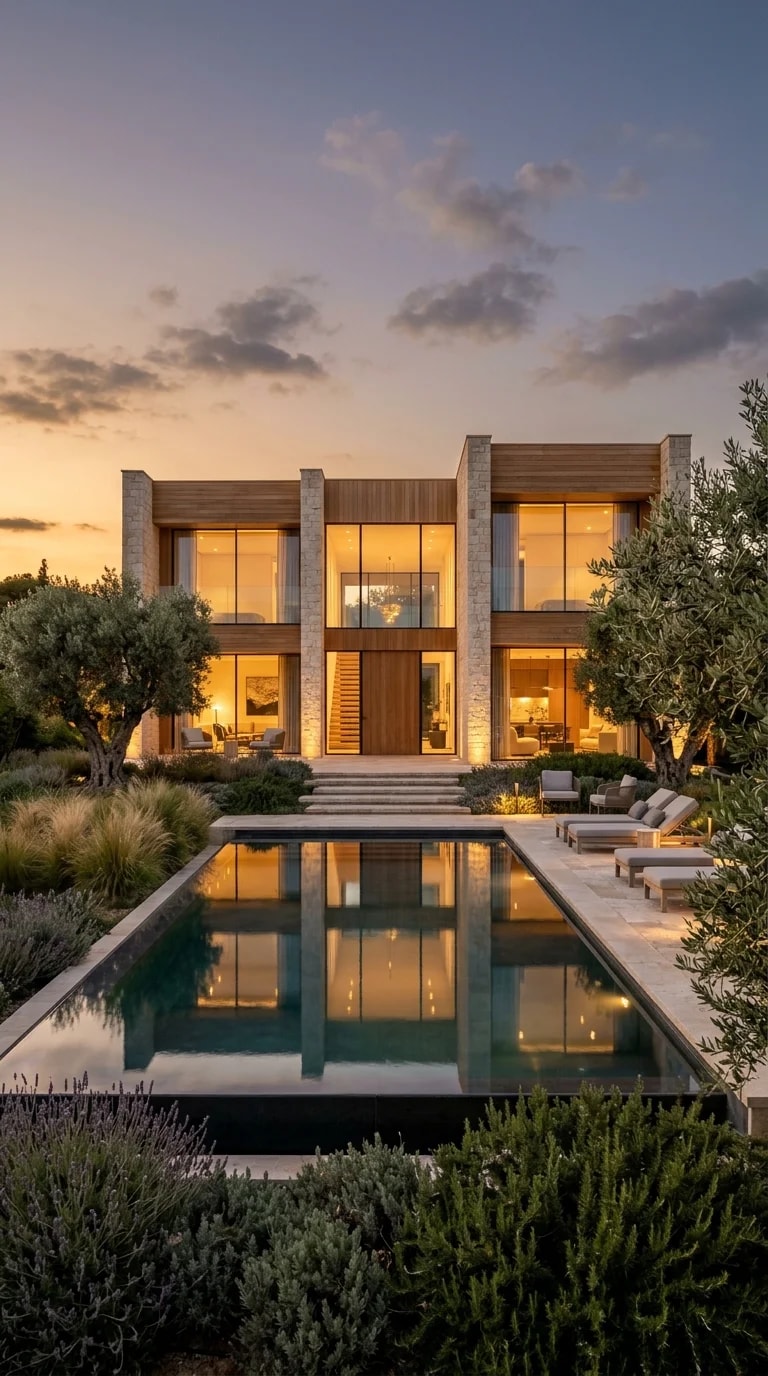
Dusk is the honest hour for judging a house. At twilight the flaws in a facade soften and the things that were designed with real intent start to glow. In this home, everything organizes itself around a single move: a long, still pool that runs from the edge of the property straight to the front steps, aimed like a pointer at a warm-lit wooden door. The sky above is cool and almost blue-black, the interior spills gold onto the stone, and the water doubles both. It is a simple trick, and it is the reason the house feels calm rather than merely large.
If you are sketching your own home design plans, steal the axis before you steal anything else. A house that gives a visitor one clear line to follow — from gate to water to door — reads as intentional even when the budget was modest. Here the geometry is strict: matching loungers, evenly spaced pillars, planting clipped low so nothing interrupts the view. Symmetry does the heavy lifting, and the pool does the rest, pulling the eye forward and making the approach feel longer and more ceremonial than the actual distance walked.
The glass is the second big decision. Floor-to-ceiling windows turn the interior into part of the facade after dark, which means your evening lighting becomes architecture. Warm, low-level fixtures inside read as hospitality from the street; a single overhead bulb reads as an office. The stone pillars and the deep roof overhang give the glazing something to hide behind, and the olive trees and shrubs layer in front of it, so the house is open in one direction and private in another. Plan that balance early, because planting takes years to catch up to a wall that goes in on a Tuesday.
Materials keep the palette grounded. Warm neutrals, timber, textured stone, and a lot of green do most of the work, letting the blue hour supply the drama for free. Olives and low, dense shrubs are a sensible choice for a pool courtyard: they hold their shape, ask little water once established, and never block the sightline you paid for. Keep the water shallow enough to stay warm and reflective, shelter it from prevailing wind so the surface stays glassy, and give the loungers real space rather than squeezing them against a wall.
The lasting impression is not luxury for its own sake but quiet. A person standing at the far end of that pool sees an invitation rather than a performance, and that is the feeling worth designing toward.