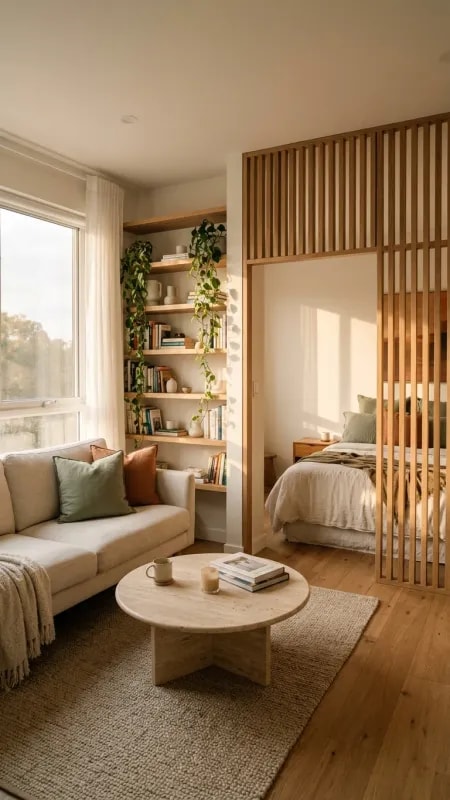
Nine by twelve feet is often described in terms of what it can't hold: a sectional, a king bed, a grand piano. But spend an afternoon in a room like that and you notice something else — the corner by the window is almost always the spot everyone drifts toward. In a compact footprint, that single tall window becomes the most valuable real estate you own, and treating it as a designed destination rather than leftover space changes how the entire room reads.
Start with the chair. A low, upholstered armchair set at a slight angle to the glass, positioned just off-center so it doesn't block the light, does more for a small room than any built-in. Choose a warm neutral — oatmeal, bone, a soft mushroom gray — so the seat recedes and the daylight becomes the star. Give it a small round side table no wider than eighteen inches, just enough for a cup, a book, and a lamp that can take over when the sun drops. The goal is a vignette that feels complete without crowding the 108 square feet around it.
Then work outward from the window with color. The most restful small rooms repeat two or three tones rather than introducing a palette. Ivory walls with classic paneling, pale oak floors, a linen curtain that pools a few inches on the sill — that trio bounces diffused light deeper into the room and makes the far wall feel closer than it is. If you want contrast, add it in texture instead of hue: a nubby wool throw, a ribbed ceramic vase, a slim brass floor lamp. Depth without visual noise is what separates a room that looks expensive from one that just looks full.
Storage should follow the architecture, not fight it. A shallow bookcase flanking the window, no deeper than ten or eleven inches, keeps the sill clear and gives the corner a sense of history — the impression that the room has been lived in and edited over years. Paint it the same color as the wall so it disappears into the surface. On a 9x12 plan, anything that hugs the perimeter and reads as part of the architecture buys you floor space and calm in the same move.
Finally, resist the urge to fill every inch. A little breathing room around the chair, a curtain that isn't yanked tight, a sill left mostly bare — these small omissions are what let a compact room feel generous. The most memorable corner in a small house isn't the busiest one. It's the one where the light lands softly, the chair is genuinely comfortable, and nothing asks you to do anything but sit down.